

What equipment and gear police officers carry depends on their assignment. Before being given special assignments, officers prepare through specific training. © Sami Hätönen.

Constables of the Turku Police Department during shooting practice in the 1920s.
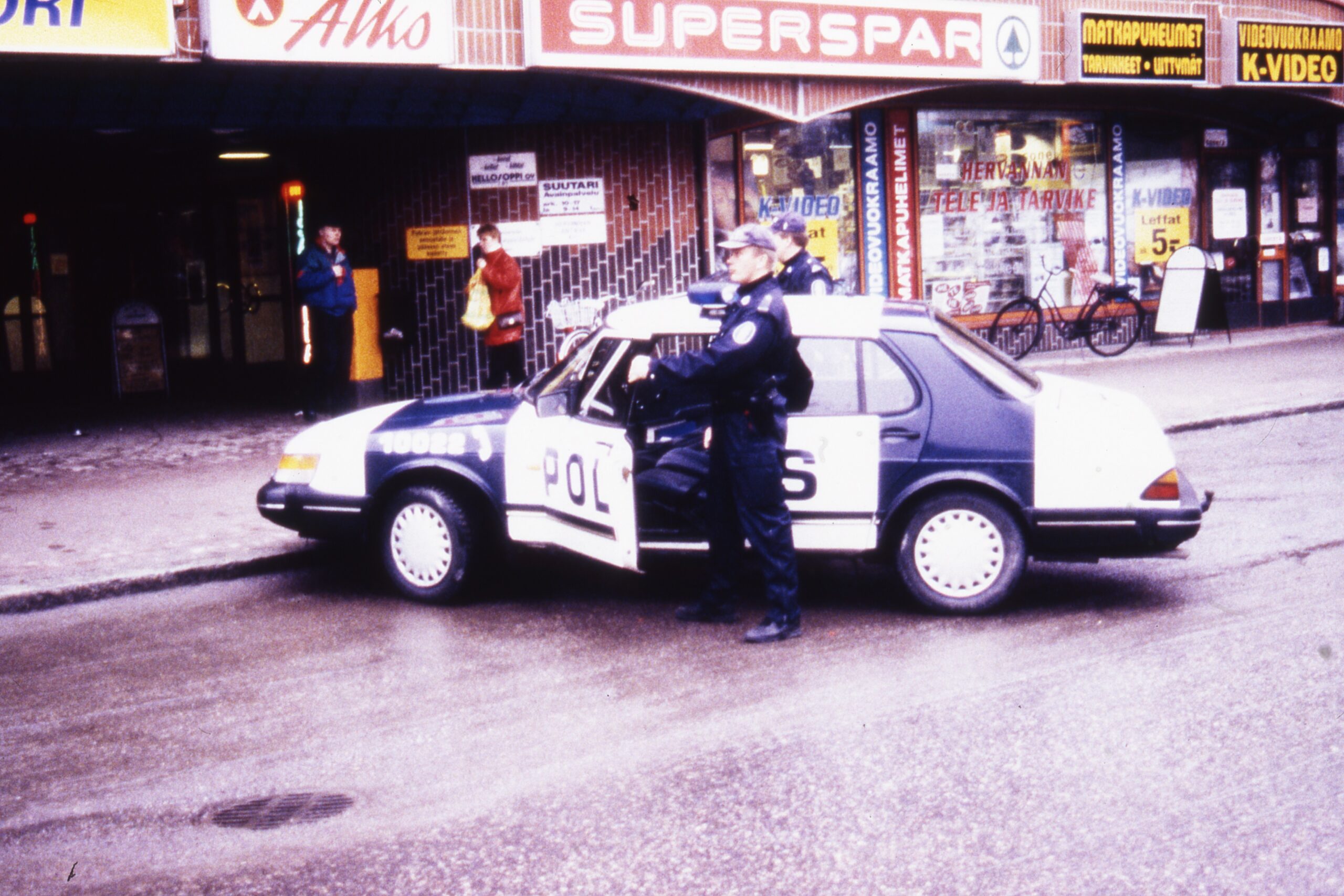
Coveralls for field use along with an equipment belt became increasingly common in the 1990s, unofficially at first and later officially.

Regular training is a prerequisite for possessing a service pistol, and the same applies to all other means of using force. © Sami Hätönen.

Many Finnish police officers have never fired a shot at a human throughout their careers. Fiction is one thing, but in the real world, the Finnish police try to use as little force as possible. The police handle around a million tasks a year, 90% of which are resolved by talking. Usually, the means of force used are mild, such as controlling a person with physical force or with milder coercive tools, such as handcuffs, batons and OC spray.
The display case showing the instruments of force is a very popular part of the Police Museum’s exhibition. Its contents are a must-see for the young and old alike. The use of force by the police is very “action-oriented” in the minds of many. Surprisingly, many people think that the police often fire their guns, even routinely on operations. This perception is fuelled by fictional TV series and games, where thrills are generated by violent car chases, shoot-outs, and the use of force. In addition, the media rush to report on any situation in which a police officer has had to discharge their firearm.
Instruments of force
The police in independent Finland have always had instruments of force. In 1918, the sword fell out of use completely, except among the mounted police and commanding officers. Instead, constables began to carry a firearm, handcuffs and a baton. The rubber baton, originally produced by the Nokia rubber factory, was in use until the 1980s. The baton had a well-known slogan: when words are not enough, you need a Nokia rubber baton. It was replaced first by a long wooden baton, and then by a hollow plastic one. The telescopic baton was introduced in the early 2000s.
The rules on whether the police carry a concealed or visible weapon have varied. For a long time, officers kept their pistols in leather holsters under their uniform jackets. Normally, officers receive their service weapons from the police department, but some officers also bought their own. Especially in the 1980s and 1990s, police officers applied for a licence for their own weapons for official use, as the “noisy old gun”, the FN m1910, was not considered very reliable. The recession in the early 1990s led the public sector to centralise and procure equipment via competitive tendering processes. The principle was that all police officers should use the same equipment. Up to then, police weaponry had varied quite a lot in terms of makes and models, both between officers and departments. Most police officers went straight from the FN m1910 to the Glock 17 or 19, which were in use between 1991 and 2010. In 2012, the Walther P99Q became the personal service weapon. In the 2020s, the police have acquired the Heckler Koch SFP-9 pistol as the service weapon.
The police began to consider limits on the use of weapons in the 1970s. The Mikkeli hostage crisis (1986) sparked extensive debate on the police’s responsibility for the use of force, and this catalysed legislative changes. Instructions issued in 1989 on the use of weapons were intended to reduce the use of firearms by police officers in the course of their duties, and they succeeded. Since then, the regulation of the use of force by the police has been further reformed and clarified. Tapani Rinne’s ‘Police Tactics’ was published in 1993, and it led to the systematic development of training in the use of force and field operations.
In the 1990s, an overall-style uniform came into use, incorporating a clearly visible belt to carry instruments of force. Constables no longer concealed their service weapons under their jackets, and the uniform trousers no longer had a side pocket for carrying a baton. Previously, the police had only used overalls for special situations, and they were used by teams such as the Karhu unit, the National Traffic Police, and dog handlers. Uniformed police officers also wanted overalls, and some were allowed to wear them with their commanders’ permission, but it was unofficial and initially only on night shifts. Permission was not always granted, because the uniform regulation did not allow the uniform to be worn by the police. The police officers who wore overalls also began to purchase suitable equipment belts and safety shoes at their own expense. The public responded positively to the police’s “proper” equipment, but some within the police force joked about it looking like a Christmas tree.
A major reform of the police uniform was completed in 1999, but it still lacked an overall for everyday use by field police officers. Following feedback from line officers, the field uniform was added to the clothing range in 2002. Changes had to be made to the equipment belt, as it was causing back problems for the officers and rubbing against the fabric on the seats of police cars when officers got in and out, causing additional wear.
Traditionally, the police have used ‘long guns’ as support weapons. As early as the 1930s, the mobile police command had machine guns, among other weapons. Today, the weapons used for support operations include semi-submachine guns, various rifles and shotguns.
The police were among the first in Europe to adopt stun guns in 2005. Today, it is standard police equipment. The FN 303, a longer-range compressed-air projectile launcher, was introduced by the police in 2014. It has been used relatively rarely by the police, for example in crowd control or animal removal operations. The dog is also an instrument of police force, which means it must be under the control of its handler and catch and release on command. The use of a police dog is subject to the same rules as any other use of force by the police.
Protective equipment
When the police carry instruments of force, it is first and foremost a question of preparedness and anticipation. The police must be ready to deal with dangerous situations. There is always a risk that the police officer or the person being targeted could be injured or even die. Nowadays, the police regularly train in the use of different tools and approaches.
Unpleasant situations have brought occupational safety issues to the fore. The shooting skills of police officers were rarely measured. The departments organised large, joint shooting days for practising. Officers would go and shoot, and the conclusion would be: you are a good shot or you are a bad shot. After that, officers were responsible for practising and honing their skills. The explosion in Mikkeli sparked a wide debate on the use of firearms by the police. Injuries or near misses occurred on missions that could have been avoided with adequate training.
A police officer was killed in a training exercise in 1995 at the Police College. This led to the systematic training of police officers in the use of weapons. Among other things, departments appointed dedicated use-of-force trainers. Today, before a police officer is allowed to carry a weapon, they must pass a training course on how to use the weapon. Regular refresher training is required for officers to possess a service weapon or any other instrument of force. Police officers must take an annual test for all the instruments for which it is specifically prescribed. One such instrument is the service weapon.
Former police officer Antti Ervasti witnessed the death of his colleague, Sergeant Taisto Seppänen, on duty in Puolanka in 1980. He recalls how the mission started. It reflects the spirit of the times and the concept of safety at work. The urgency of the mission took precedence over safety.
A woman working at a restaurant called and said she had seen a gunman in the window holding a long-barrelled gun, although he had not come inside. …When I told Taisto, he said, “Let’s get there quickly. We need to leave right now.” At the time, protective vests were not in regular use. They were really heavy; made of metal not an advanced fibre. It was difficult to move when you were wearing one, so we often avoided using them whenever we could. In Puolanka, there were two vests, and they were kept in a basement storage room behind locked doors. There were also machine guns in the same place. We also had a shotgun in the back of the police car. Taisto decided it was so urgent that there wasn’t time to get the vests. As a junior constable, I wasn’t about to start arguing with him. Excerpt from Otimme pistoolit mukaamme ja hyppäsimme Saabiin. Rantanen Linda, Suomalaiset poliisisurmat, 2024. (We took our pistols with us and jumped in the Saab. Rantanen Linda, Finnish Police Murders, 2024.)
The earliest protective equipment was heavy and cumbersome. For example, a heavy-duty Akvarex protective vest weighed 17 kg. Lead at the front, nothing at the back – that is how one retired policeman described it when visiting the museum. From 1994, a lightweight personal protective vest became compulsory. Today, every police officer has one. The tactical vest came in 1995. The helmet and tactical vest are personal or shared equipment, depending on the mission. In addition to special personal equipment, police officers in special units have their own team-specific equipment, which takes into account the local needs. The critical incident response team has first aid, protection and camouflage equipment, lights, night-operation equipment, and vehicles suitable for the action at hand. The team also receives training in emergency first aid.
Training, advanced equipment, and regular practice guarantee the safety of police at work. In the 21st century in particular, the materials and technical characteristics of equipment have evolved. In addition, user feedback is considered during product development.