

Constable Vihtori Maakala’s service pistol which he used when two drunken men forcibly entered his house in May 1931.
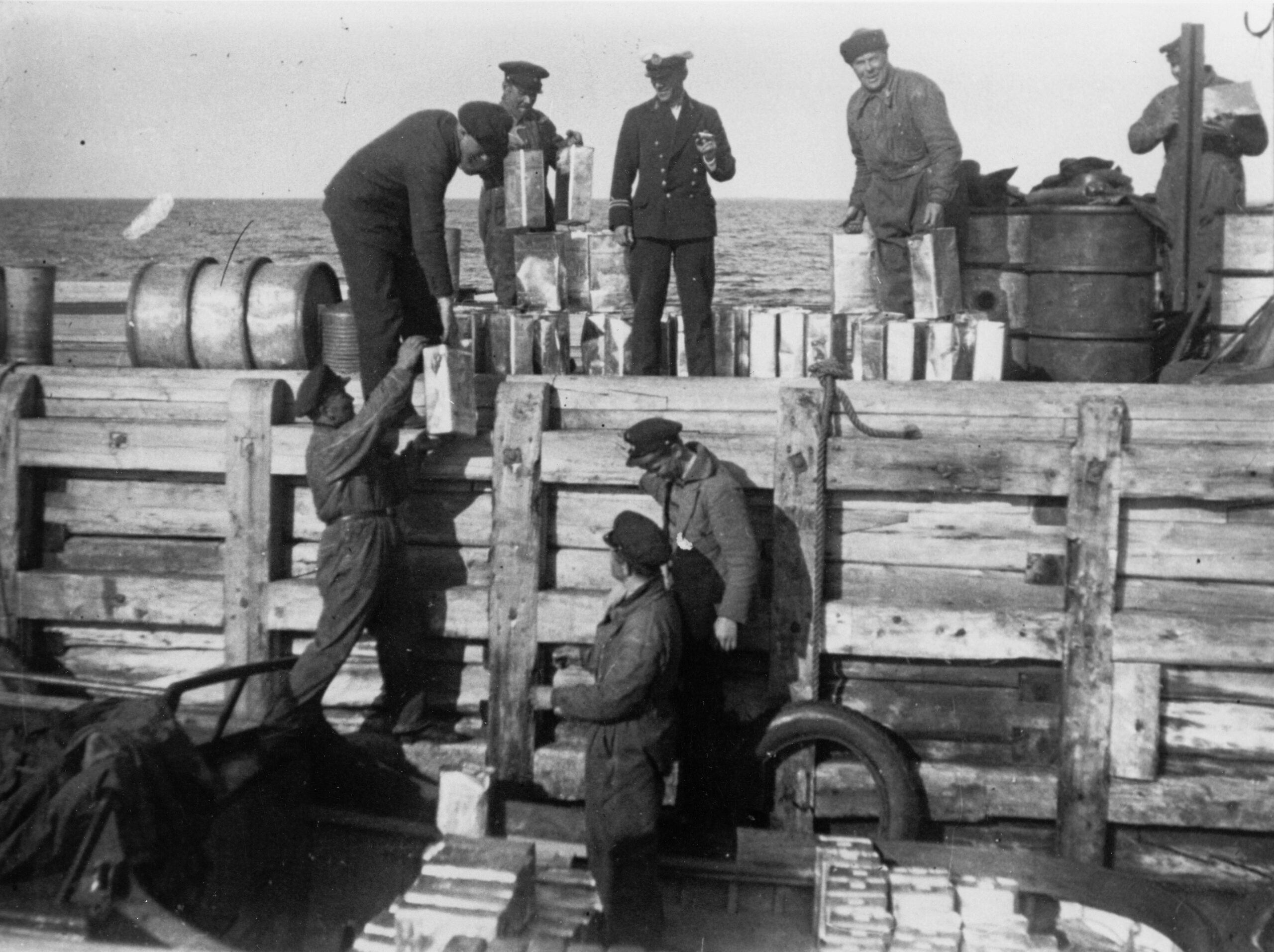
Violating Prohibition (1919–1932) became commonplace. Smuggling and selling illegal alcohol turned into a widespread organised business activity. Seized alcohol containers being unloaded from a boat.
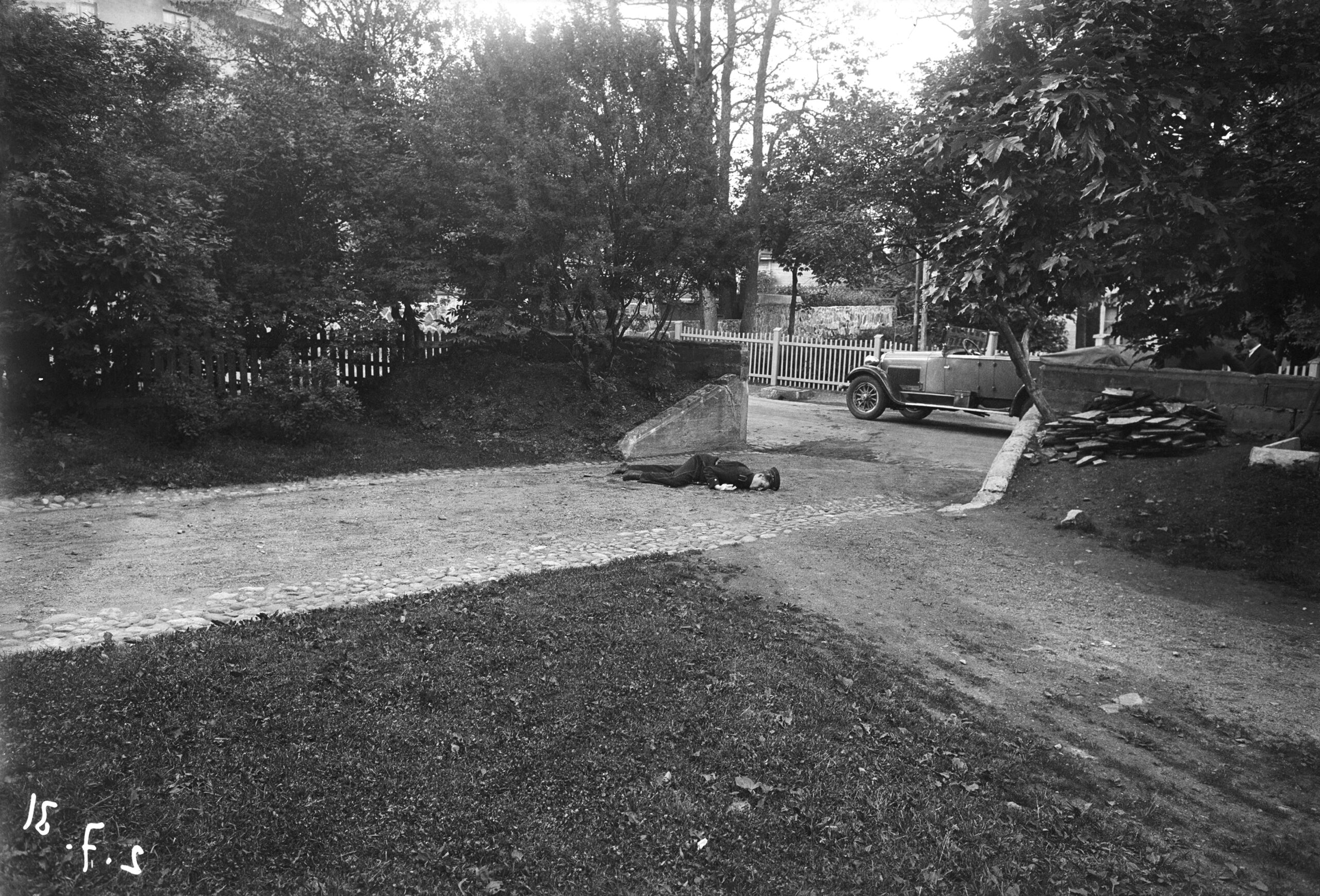
In 1931, Junior Constable Eino Heinonen was found in Kaivopuisto in Helsinki after having been stabbed to death.
Mortal danger during Prohibition
Mikko Porvali
The social problems of a young state and Prohibition
he Prohibition Act (formally the Decree on the Manufacture, Import, Sale, Transport and Storage of Alcoholic Substances) entered into force in Finland in 1919. The law had been adopted in the Grand Duchy of Finland during the Tsarist time but, due to political upheaval, it only took effect in the newly independent republic. The law was in force until 1932. The nation onto which Prohibition was enacted faced a variety of difficulties in terms of law, order and enforcement. The country had suffered a civil war the previous year, which had made the social climate more brutal, both in terms of actual fighting and mutual terror. The urban battles in Tampere and Vyborg had left behind destroyed buildings and a large number of war orphans. Poverty and unemployment were rife, exacerbating social problems.
The total prohibition of alcohol created the foundation and a market for a large-scale alcohol smuggling, which soon became an organised criminal activity. Alcoholic beverages were imported in bulk from Poland and the Baltic states across the sea. Networks formed in the country, making immense profits from the illicit sale of alcohol. As their financial interests grew, these networks were quick to resort to violence to defend their patches. The violence was worst between rival groups, but the police also played a part. The recent war and the defence of criminal interests lowered the threshold for violence, making police work more dangerous.
Prohibition quickly became unpopular and widely disobeyed. This led both to a general decline in compliance with the law and corruption among officials. The police were not very motivated to enforce the unpopular law, and not always even to obey it themselves. During the smuggling era, only the wealthiest people could afford mild alcoholic beverages, which prompted a large proportion of users to switch to spirits, known as moonshine, which were easier to smuggle. Strong alcohol tended to aggravate and exacerbate the situations in which alcohol was consumed. Although the police lacked the motivation to enforce prohibition itself, they were constantly confronted with alcohol-related crime, disorder and social problems.
Prevalence of firearms
After the civil war, firearms were widespread and readily available. Small pocket guns, such as revolvers, were popular among criminals and were often used against police officers. A police officer’s working day could end in an unexpected and dangerous situation where their life was at risk. The prevalence of pocket guns made the work of police officers particularly risky, as they did not have appropriate protective equipment or weaponry to respond to such threats.
During Prohibition, Finland experienced an exceptional wave of violent crime. At the end of Prohibition, as the 1920s gave way to the 1930s, almost 100 people per 100,000 inhabitants were killed in Finland every year. In the late 1920s, it was more likely for a person to become a victim of homicide in Finland than in the gangster wars of Chicago or in the clashes between Eastern European mafia organisations in the 1990s following the collapse of the Soviet Union. This was the most violent period in Finnish peacetime history, excluding a localised wave of homicides by knife-wielding thugs in a few parishes in South Ostrobothnia
A more brutal atmosphere and political polarisation
The period of violence had a major impact on the safety of police work. Post-war bitterness and social divisions were reflected in everyday life and in the situations encountered by the police.
Even in the early days of independence, the police were not a force that the whole nation considered safe and trusted. Police officers were recruited from the ranks of the Whites, who won the Civil War, and for quite a long time, employment as a police officer required assent from the civil guard. In rural areas in particular, the civil guard was the only police reserve, and they were obliged to support the police when it was necessary.
The police had to demonstrate through their actions that they enforced the law equally and fairly. This did not suit everyone, especially people with more extreme political views. The Finnish Communist Party was forbidden by law, and they were prepared to use violence to spread their ideas if they were threatened with capture. At the same time, right-wing politics sought to deny the police the right to investigate acts of violence committed by the Lapua movement “in the name of the people”.
As divisions in society deepened and the extremes moved even further apart, the police could ultimately no longer rely on the support of right-wing forces to enforce order and social equality. This led to the creation of the Mobile Police Command in 1930 to guard against right-wing radicalism. The Mobile Police Command was equipped with rifles and armoured cars, and its original mission was to uphold the rule of law, especially against coup attempts. A rebellion broke out in Mäntsälä in February 1932.
Police often worked alone
In an unstable social climate where the sale of alcohol was banned, the police were sometimes openly seen as the enemy. An atmosphere of distrust and brutality made policing and investigating crimes challenging, and police officers often faced hostility and violence in the course of their duties.
Police officers, especially in rural areas, often worked alone, which increased their vulnerability. Police officers working alone were susceptible to surprise attacks and dangerous situations where they had no escape and no way to get help quickly enough. Communication tools, such as radio phones, were not yet available. This left police officers alone in dangerous situations where their safety was threatened.
Members of the public had plenty of firearms, but the police often lacked the tools and the training to use them. The standard of equipment varied, and many police officers bought a pistol for protection with their own money. Protective equipment of any kind (such as body armour or bullet shields) was not yet known in this era.
Police losses
More than 40 police officers were killed in the line of duty during Prohibition. Over thirteen years, a police officer was killed in Finland on average every four months, meaning three deaths per year. In most cases, a police officer was killed either by a drunken alcohol seller, a smuggler fleeing arrest, or a drunken youth who brought a gun to a dance. The era has gone down in history as one of the most dangerous periods for police work in Finland.
Killinngs in Lamminkylä in 1931
Maritta Jokiniemi
The following story describes one of the most brutal police killings of the Prohibition era. Two policemen were targeted with violence, along with their homes and families.
Two “hooligans and bootleggers” had long been sowing terror in Lamminkylä (today known as Lamminpää in Tampere) in Northern Pirkkala. On the evening of 12 May 1931, Vihtori Maakala, a constable from the village, was called out to stop a brawl. The constable confiscated a Mauser pistol from fighters and took it to his home.
The drinking continued, and the men went out at midnight to intimidate the villagers by breaking windows and causing other disturbances. At one o’clock in the morning, a villager ran away from the troublemakers and came to Maakala’s home. The hooligans pursued the villager and broke into the constable’s home, demanding their pistol back. Maakala tried to get the men out of his house, but one of them hit him with a hard object. The constable tried to reach for his service weapon, which was in a drawer in his desk. He opened fire at one of the intruders, but, bleeding from the earlier attack, he could not see properly. Then the pistol jammed, and one of the intruders tried to hit him with an axe, but his wife, Eeva Maakala, managed to prevent the axe from connecting.
Maakala thought that if he left the house, the intruders would come after him and leave his family alone, so he decided to exit the building. The injured Maakala headed for Epilä police station on foot to call for backup. The station was about 2 km away. Once there, he spoke to Sergeant Anton Lundqvist, who called for a rental car and driver, as well as constables Frans Vilhula, Sulo Mikola and Deputy Akseli Saukkonen.
Reinforcements arrived as soon as they could, and upon arriving at Maakala’s home, they were met with a horrific sight. The intruders had killed Maakala’s 24-year-old wife, and the family’s young daughter, aged under 2, was crying next to her mother’s body. In addition, the intruders had ransacked the home.
The perpetrators waited for the police near the scene of the murder and, after the death of Eeva Maakala, they had time to acquire another weapon. They saw a police car in front of the Lamminkylä Voima store and decided to go over to it. The driver tried to delay the men, who were behaving threateningly, as the police officers were inside the shop calling for reinforcements from Nokia.
When the police came out, the men immediately started shooting. In the incident, one of the perpetrators was hit in the leg, and Sergeant Anton Lundqvist was hit in the stomach. He was taken to Tampere General Hospital, where he died of his injuries later in the day on 13 May 1931.
A disgusting, outrageous act of revenge, unparalleled in its brutality. The press reported the events in great detail. It turned out that the perpetrators had a grudge against the police and had previously threatened the officers with revenge. Helsingin Sanomat reported on “a massacre of extreme brutality” and Aamulehti on “a disgusting, outrageous act of revenge, unparalleled in its brutality”. A citizens’ meeting was held in Tampere to call for the death penalty to be reinstated in Finland.
At Pirkkala District Court, the killer of Eeva Maakala and Anton Lundqvist was sentenced to life in penitentiary for the violation of domestic peace, unauthorised possession of a firearm, violation of domestic peace, property damage, manslaughter and murder.
A second perpetrator was sentenced to 13 years in penitentiary for violation of domestic peace, unauthorised possession of a firearm, property damage, and the attempted murder of Constable Vilhula.
Epilogue
In spring 2019, Raili Leponiemi came to the Police Museum with her son Seppo. They handed over the service weapon that had belonged to Raili’s father, Vihtori Maakala, and other material about his life. Raili Leponiemi, almost 90 years old at the time, was the little girl the police found next to Eeva Maakala’s body. She does not remember the events herself but has heard stories about them. Her father did not work as a policeman for much longer after that. He became a farmer in Mouhijärvi. Raili’s son, Seppo Leponiemi, had received Vihtori Maakala’s service weapon from his father. The weapon is the same as the one used by Maakala in the situation described above. However, the gun had jammed and did not work.
Police Museum Facebook post, 9 April 2019.
Arresting smugglers
Anti-Alcohol Detectives Paavo Hämäläinen, Armas Pulli and Iivari Peltoniemi set off to Humaljoki to intercept a shipment of moonshine on 14 June 1928. At the lake shore, they spotted a vehicle being loaded with canisters of moonshine. The detectives arrested three smugglers and set off with them towards Koivisto. Peltoniemi drove the police car, and Pulli and Hämäläinen followed in the vehicle full of moonshine.
During the journey, Peltoniemi noticed that he had lost sight of the other vehicle, so he turned around. At the same time, Sihvonen and Seppinen, two merchants, came and said they had noticed two men lying on the roadside. When they returned to the scene, they found Pulli and, 100m away from him, Hämäläinen. Both had been shot but were still alive. However, they died of their wounds as they were lifted into the car.
The entire local police force and civil guard were immediately called in from Koivisto to pursue the perpetrators. At 10 pm, a vehicle carrying moonshine was spotted in the village of Kolkkala in Kuolemajärvi. It had driven into the forest at high speed. The vehicle was carrying 210 litres of moonshine. The smugglers were caught in the morning in Perkjärvi.
On 16 February 1921, Senior Constable Matti Lindgren brought a jaeger lieutenant, caught drunk and disorderly on the street, into the Vaasa guard station. The man had been calm during the journey. However, upon arriving at the police station, he pulled out a Browning pistol and fired several shots at Lindgren and Sergeant Juho Järvi. Both police officers were killed instantly, and the shooter fled through a window.
Others at the station heard the shots and went after the man, but he managed to escape. He was caught later in the night in the attic of a house on Rauhankatu. He explained that he had been so drunk that he thought he was fighting the Bolsheviks near the border.