
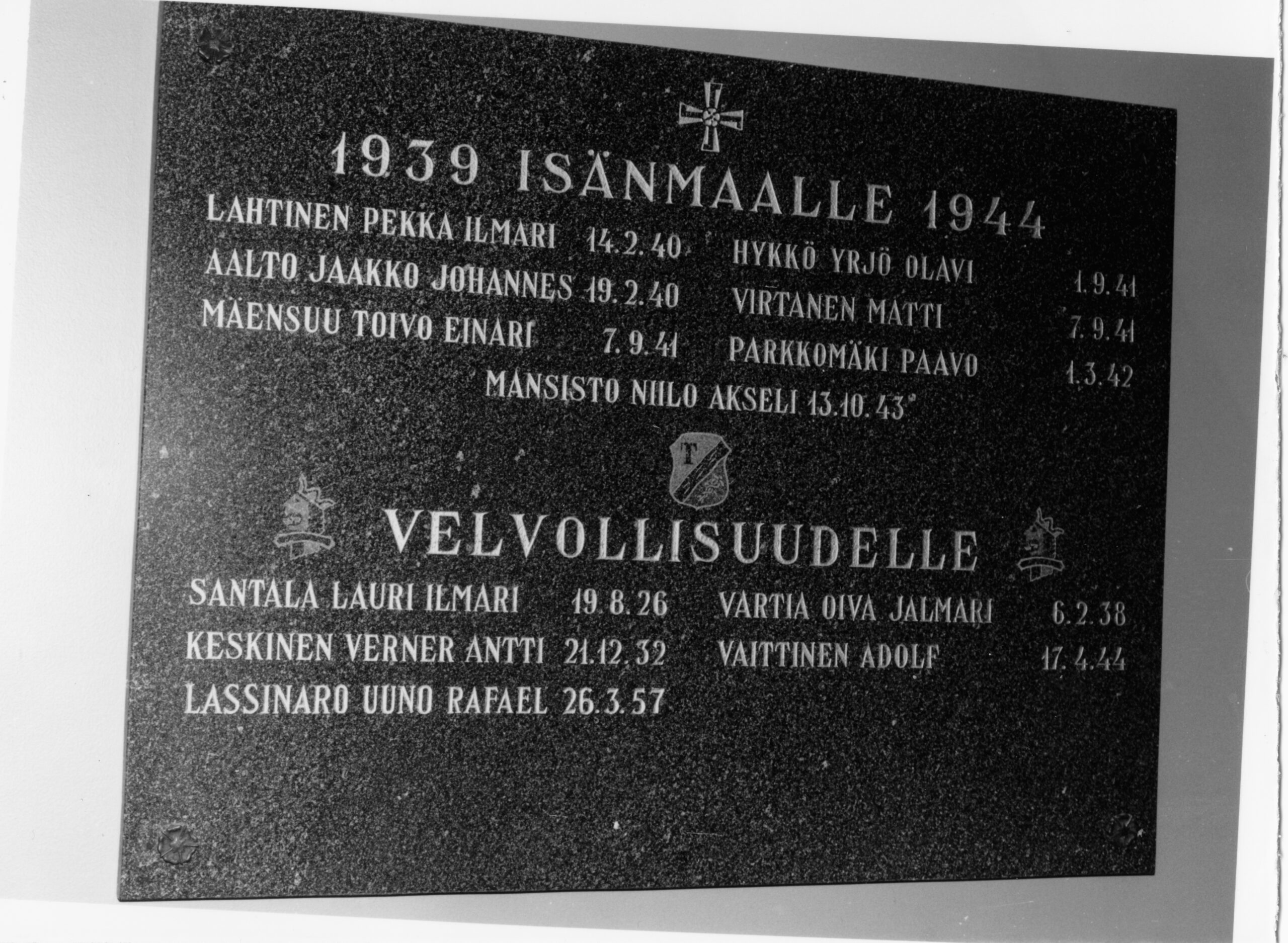
Memorial tablet in Tampere. Memorial tablets with the names of fallen officers can be found at least at the Helsinki, Southwestern Finland, Ostrobothnia, Central Finland and Eastern Uusimaa Police Departments.
The subject of police officers who die in the line of duty is certainly of interest to a large number of people, including me. While comparing lists and stories of old cases, I noticed a lot of discrepancies. Names, dates, years and cases varied and got mixed up.
The issue began to bother me to the extent that I started to look into the subject in more depth. The amount of material available varied greatly depending on the case. All the material and information I have been able to dig up is from open sources. I have not scoured the official systems for any information on the topic. In any event, I am not entitled to do that, because it is not related to my job. In the case of Tomi Keskinen, I recall some of the things I heard in the message traffic, as I was at work on that tragic night.
I used a lot of Suomen Poliisilehti and Poliisimies magazines as sources. I also found a lot of factual errors when looking for birth dates and places. The time of death may also have been incorrect, even when newspapers had reported cases fairly recently. I could think of no better way to ascertain the time of death than to check the gravestone. It was a big job to find out where everyone was buried, with varying degrees of help from parishes and cemetery managers. In this endeavour, I again came up against data protection regulations, which, in some cases, prevented people from disclosing information to me.
Nowadays, there are various grave search engines, and these were a great help. Unfortunately, some of the older graves no longer exist because there is no one to look after them. Each spring, I waited for the snow to clear so I could tour the cemeteries, because often you just have to systematically walk around the cemetery looking for the right grave. Of course, on many occasions, I met a cemetery caretaker who told me where I could find the grave I was looking for. I have driven the length and breadth of Finland to carry out this work, which has consumed numerous days of my free time and holidays in the summer. And there is still plenty to do.
The National Library’s digital archive has also been a very important source of information. In many cases, old newspaper reports shed light on the course of events, death notices specified the burial place, and provided information about the officers’ careers and families.
I was also troubled by the fact that only violent deaths were recorded as deaths in the line of duty. Police officers have died in accidents during their shifts, whether in training, on the road, or in other work-related situations. Another group that was previously overlooked is the people who worked as police officers during the war. Although they did not go to the front, they nonetheless died as a result of military action, such as bombing. I think these people should also be counted among those of died in the line of duty. I would like to see their plaques added to the memorial wall. There are also some embarrassing cases for the police organisation. In some cases, an officer was on duty but was doing something completely different from what they were supposed to do, and ultimately died while working as a police officer. They are then in a category of their own in this sad list.
During this project, I came into contact with some of the relatives, spouses, children, siblings and colleagues of the deceased. The discussions were fruitful and stirred strong emotions on both sides. Although my questions brought back some sad memories, people found it important that their late spouse, father, relative and colleague are still remembered. In some old cases, I was also able to describe the course of events to the relatives. In the past, the person may only have been known as the police officer in the family who died in the line of duty.
Tommi Nevalainen
Guard
Eastern Uusimaa Police Department