

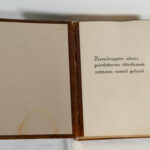
Memorial book dedicated to police officers who have died violently while performing their duties. The book was made by the student body of the Police Academy. ©Jarkko Järvinen/Police Museum.
Police officers killed in the line of duty are a subject of interest to the general public, genealogists and the media alike. Of course, for the police themselves, this is an important and painful reminder that missions do not always end well. The losses are an important piece of history that the police want to remember and respect. It is often said that when you decide to join the police, you must be willing to accept the hazards of the job. To this end, the police have long worked to develop their operations. High-quality graduate training, specialisation in demanding tasks, modern tools and equipment, technology, and regular training are the safeguards. When the basics are in order, real life is less likely to leave lasting scars.
In 2008, Pohjolan Poliisi Oy published a book called In Memoriam 1917–2007 – Police Officers Killed in the Line of Duty. A database was created based on the work and made available in the Police Museum exhibition that opened the same year. As our computer technology became obsolete, we had to shut down the database and there was no widely available work on the subject. However, the museum’s information service regularly received enquiries on the subject, spurring the idea to make this important topic as widely available to the public as possible. The idea of an online exhibition that anyone can browse was born. In Sweden, a public database of police officers who have died in the line of duty and the events leading to their death is maintained by Swedish police officer Niklas Lindroth.
Tommi Nevalainen, a guard at Eastern Uusimaa Police Department, contacted the Police Museum to told them that he had been diligently researching the topic for years and had collected a large amount of material, including notes on police deaths and photographs of the graves of the police officers who had died. Without Tommi’s tireless help, this online exhibition would have been a lot more work.
In the 1960s, the Police College in Espoo started collecting information about police officers killed in the line of duty, and a memorial wall was erected in the college. Even then, information about the cases was based mostly on obituaries in police journals and newspaper articles. In addition, other police forces, at least in Helsinki, Vaasa, Turku, Tampere and Vantaa, have their own memorial plaques.
In 2008, the plaques were moved to the Police University College in Tampere. In 2025, there are a total of 131 plaques. Each plaque conceals a host of sad events: how the bad news was broken to the family, how the work community lost a valued member. They symbolise the greatest sacrifice that police work can demand.
The criteria for who is considered to have been killed in the line of duty have varied. Under the strictest interpretation, only those officers killed through external violence have been memorialised. This excludes, for example, those who died in traffic accidents, other accidents, and on the home front during the war. Deaths during leisure time have also led to differing interpretations. Some have received a plaque, some have not. Throughout history, some of the oldest cases have been lost or stayed only within families.
The database is a standalone entity, and it neither supplements nor takes away from the existing plaques. The database already has more records of names and cases than the memorial wall – a total of 164 entries. The extra 33 are very different. Accidents that caused the death of a police officer could have included road accidents, careless handling of a weapon during a training exercise, or drowning while on duty. The unfortunate outcome was that a police officer or a police employee has died in the line of duty. We did not set out to judge which fatal events are more valuable or respected than others. Unfortunately, we cannot promise that the database of police fatalities in the online exhibition contains every name that belongs there. We already know that further research will be needed to cover the Civil War and the Second World War. Our website and database will be updated. Data may be refined, added and edited. Of course, we dearly hope that it will not be necessary to add anything to the database in the future.
Exhibitions are always made together, which is why this online exhibition involves the work of many people and institutions. I would like to thank them for their hard work on this important topic.
Tampere, 8 October 2025
Maritta Jokiniemi
Curator
Police Museum