
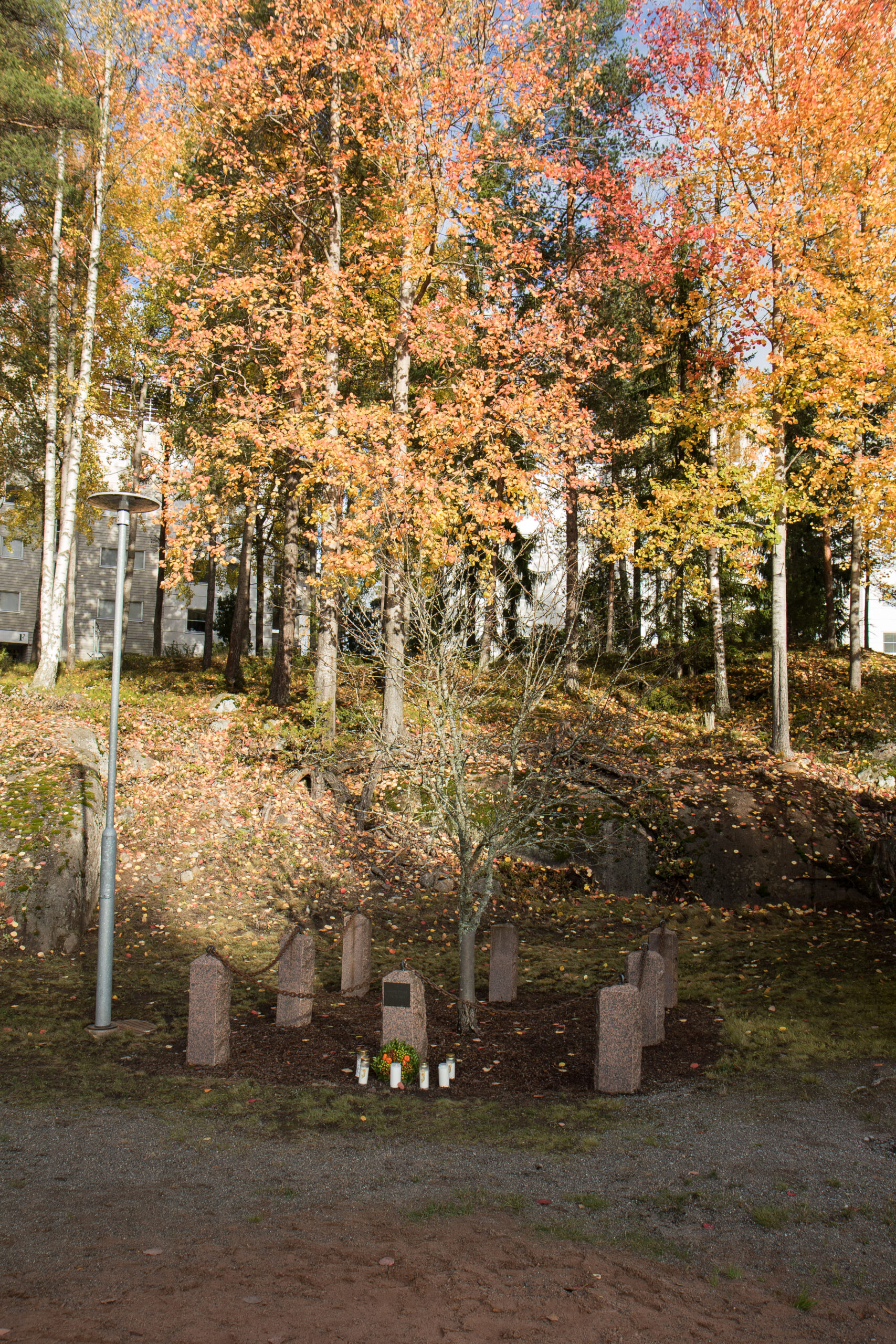
Senior Constable Kuisma Pihlaja died accidentally during training on 12.10.1995. A rowan (Finnish: pihlaja) was planted in his memory on the grounds of the Police School, which currently serves as the campus of the Police University College. The accident led to profound changes in how training was conducted, and safety aspects were prioritised in police education. One of the most tangible changes was the development and introduction of chamber safety flags.

Detective Frans Valmunen was killed in a residential building on Pihlajatie in Helsinki in 1954. The perpetrator tried to escape from the third floor by climbing down the vines along the wall. He lost his grip, however, and fell to the ground breaking his leg. The perpetrator was not prosecuted since he was considered to be not of sound mind.

On February 6th 1938, Sergeant Oiva Vartia was killed in a high-rise residential building at Hämeenpuisto in Tampere. The killer was a fellow policeman, a mounted constable who was suffering from a mental disorder. Vartia was shot in a lift, and the weapon was a police service pistol. The shooter was not prosecuted since he was not of sound mind.
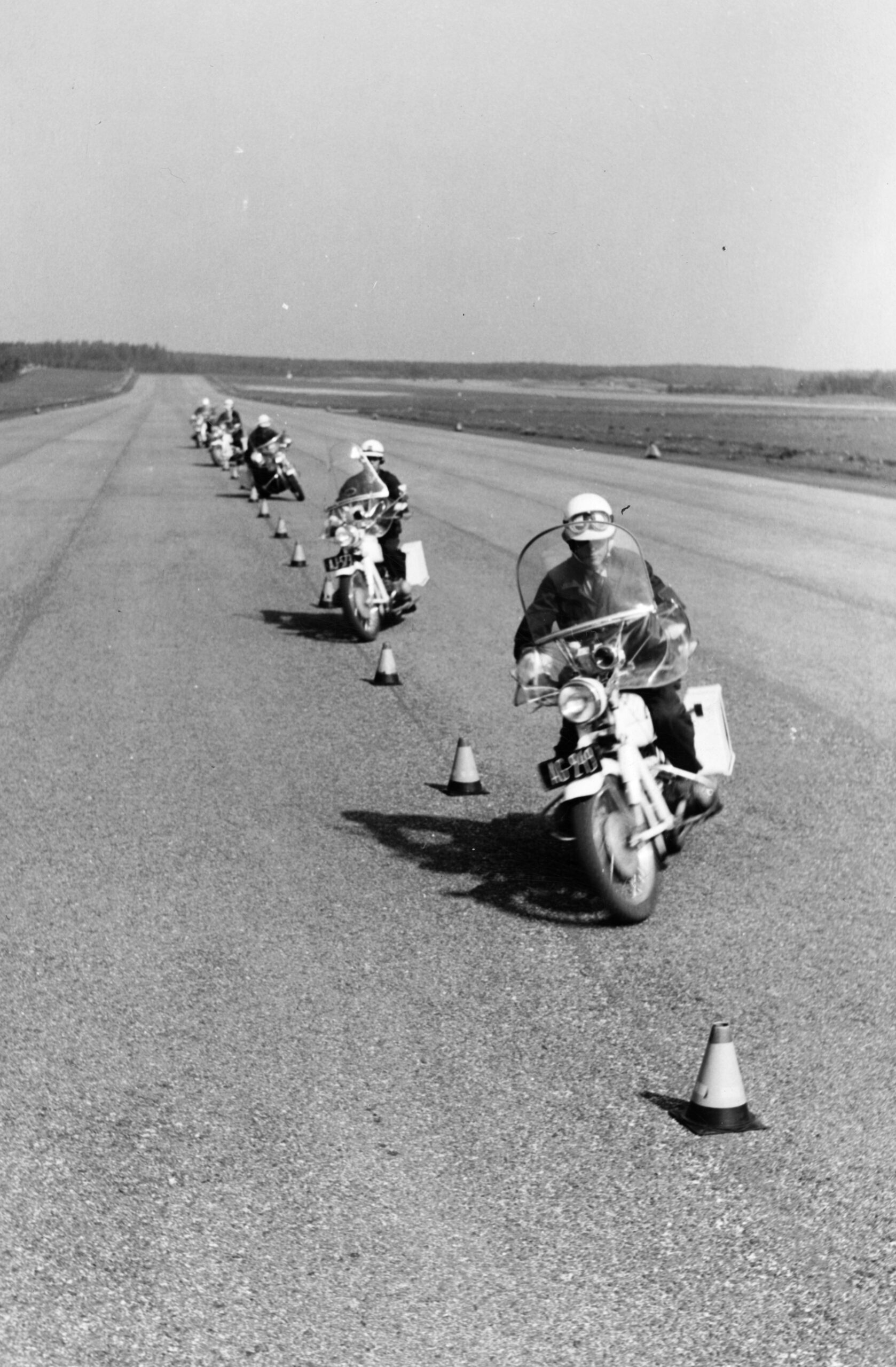
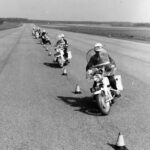
Motorcycle police training in the 1960s. The most recent accidental death of a motorcycle police officer occurred in 1968. A motorcycle was speeding northbound on Mäkelänkatu in Helsinki. Senior Constable Jukka Airikainen tried to catch the speeder, but when Airikainen reached the Koskelantie intersection, a bus ran into him.
The oldest and most extensive area of police activity is public order and safety. It includes surveilling public places, taking in intoxicated persons, security at public events, domestic and other call-outs, and difficult special situations. On every mission, even a routine one, something unexpected can always happen. The situation can turn life-threatening in the blink of an eye. Some of the examples are from decades ago, when police operating models, tools and equipment were different from today.
A Christmas Eve tragedy in Riihimäki
On Christmas Eve in 1950, the Riihimäki police received a report that a local traffic agent was abusing his family. Junior Constables Eino Kääriäinen and Ailo Virtanen went to investigate. The police had visited the address before because of the man’s disruptive behaviour. The house was near the police station. Waiting inside were a man and his mother-in-law, whom he had forced to stay. The rest of the family had fled.
The police spoke to the man, and he seemed to have calmed down. However, he had been hiding a pistol behind his back the whole time, and suddenly he began pointing it at the police. The man stood up and pointed the pistol at Constable Virtanen, who tried to grab the man’s hand, but it was too late. The man fired at him and Virtanen fell to the floor. He had no time to draw his weapon. Kääriäinen attempted to come to the aid of his colleague. The man shot him too. Kääriäinen was not carrying a weapon.
At 9:45 pm, a new report of a shooting was received, and the police chief and three constables went to the scene. They encountered the man in the yard with a gun in his hand, but he surrendered without resistance. Virtanen died in the arms of his colleague. Eino Kääriäinen’s body was found a little later in the yard behind a bus. The man had been angered by a gift his daughter had received from a foreign pen pal.
The events shocked the nation, all the way to the top echelons of government. Prime Minister Urho Kekkonen, among others, expressed his condolences. A crowd gathered outside Riihimäki police station, resembling a lynch mob. They demanded to get their hands on the traffic agent. On Christmas Day, the bus operator had to be transferred to a safer location in Hämeenlinna County Prison. He was later sentenced to life imprisonment.
Kääriäinen was survived by his wife and six minor children. Virtanen was survived by his wife and three-year-old twins. The police union and the Finnish National Sports Federation launched a collection to help the families of the victims in distress. Money and donations were also brought to Riihimäki police station. Collection lists brought to the Helsinki office of the Uusi Suomi newspaper showed that 45,890 Finnish markka was donated on the first day. The Council of State also decided to grant aid to the widows of police officers.
The funeral service took place on 7 January 1951. It was estimated that up to 10,000 people attended the event.
An escalating custody dispute
On the morning of 9 July 1950, the police provided official assistance in a child custody dispute in Porvoo. Police Chief Bertel Winberg had gone with a child’s mother, her current husband and Constable Sigurd Karlsson to collect a 9-year-old boy from the family’s former home. The court had appointed the woman as the guardian of the child. The police chief knocked on the door and asked the occupant to open up. He refused, saying he had to get dressed first. When he did not open the door despite repeated requests, the police chief and the constable broke the window of the villa’s porch and climbed in. While they were looking for something to open the door with, the man started shooting through the window. The police chief was a metre away from the door and had no time to protect himself. The man turned his gun on the constable, who had jumped out of the window and gone to call for backup. The ex-spouse was standing on the steps in front of the front door. One of the bullets fired by the man hit him fatally. Police Chief Winberg died a short time later at the scene. The woman’s husband, who was standing on the other side of the house, was rescued. Reinforcements from the police arrived later. When they got to the house, they discovered that the man had killed his son and himself.
Tracking robbers
In Savonlinna, at 12:30 am on 4 August 1977, the police received a report of a burglary. According to an eyewitness, two men were seen breaking into the Kauronen hardware store on Satamakatu. Three police constables, Jouko Konsti, Matti Pesu and Paavo Vellonen, went to investigate. Based on the information they had received, they assumed it was little more than an attention-seeking exercise by a young person.
After spotting the police, the burglars tried to escape through a window facing the street, but they were met by the police there too. The men rushed to the back room, but there was no way out that way either. The burglars then returned to the street side of the building, but were confronted by Constable Pesu, who came in and grabbed one of the men. A shoot-out ensued, with several bullets hitting Pesu. Konsti was also shot at three times but was not hit.
The burglars were escaped prisoners. One was caught immediately. A dog patrol caught up with the fugitive from Oulu County Prison a couple of hours after the shooting, about a kilometre from Kasinonsaari. He was still armed but did not resist arrest. The weapons used in the murder had been stolen the night before in Kouvola. The day after the killing, it emerged that Pesu had been shot with two different guns, probably by both burglars. Pesu’s killers were sentenced to life imprisonment.
Senior Constable Jouko Konsti, who was involved in the incident, recalled the events decades later. The officers had gone out without protective equipment, as was the custom at the time. After the incident, he continued to work mainly in the field and retired in 2004.
The experience of the call-out to the hardware store made me more cautious and more eager to protect myself from potential danger, but quitting my job as a police officer was never an option. Nor was there any reason to regret our actions: we were called out, and we acted as the police did at the time. It seems to me that if Matti had not been the first to go in, it would have been me instead of him, and I would have suffered his fate. The cold-bloodedness and indifference that awaited him that August night at the hardware store could not have been foreseen. Later on in his career, Konsti faced several sticky situations, and since then, it became possible to speak to a professional about these moments. He felt no need to do that. Perhaps the fact that a colleague had been shot while standing next to him was in some way hardening. Excerpt from Exactly 40 years have passed since the police murder in Savonlinna, Itä-Savo 4 August 2017
A bank robbery in Virrat in 1981
A man robbed the Virrat branch of a cooperative bank in Vaskivesi at gunpoint on 4 November 1981 at 2:45 pm. The man took the money and fled on foot, after which the bank employee immediately alerted the local police. As the direction of the robber’s escape was unknown, police officers from Ruovesi, Ylöjärvi, Mänttä, Parkano and National Traffic Police were called to help. Two police dogs were also involved in tracking down the robber.
Following a tip-off from the public, Sergeant Osmo Rajamäki from the Ruovesi police district went out alone to follow some footprints found in the snow between Vaskivesi and Ruovesi. The suspect was apprehended about three hours later on a highway, just a few kilometres from the bank branch that was robbed. A small-calibre revolver was found in the man’s possession. When arrested, the man said he had fired several shots at the police officer who was pursuing him. Rajamäki was found dead on the ground. He had been hit by several shots, some from close range.
Traffic deaths
Mounted police were patrolling in Raunistula, Turku, on the evening of 7 October 1930. They were trying to catch a couple of cyclists riding without lights when a bus approached the horses. The bus stopped, and the police officers were about to pass it when a cyclist appeared from behind, directly in front of the horse of the Mounted Policeman Eino Tuomi. The horse tripped on the bike, and Tuomi was thrown from the saddle, leaving one leg dangling from the stirrup. The frightened horse bolted, and Tuomi was dragged behind the animal, fracturing his skull. Tuomi died in hospital about an hour later.
On 17 February 1966, a cavalryman deserted the main guardhouse at the Hennala garrison in Lahti. The man had taken a submachine gun and magazines of ammunition with him. The fugitive was thought to be heading back to his hometown, Helsinki, so the police in the capital were informed of his escape in the early hours of the morning.
The police deployed patrols on the road into Helsinki from Lahti. In the early hours of the morning, Constables Timo Mikkola and Reino Harjunpää were called to the scene to check vehicles. The patrol was in Malmi, some distance from the Viikki junction towards Lahti. After six o’clock, a tanker truck arrived. The fugitive had hitched a ride on the tanker. As the police started to search the vehicle, the deserter fled the scene. Constable Harjunpää spotted him and ordered him to stop. The man responded by firing the submachine gun at Harjunpää.
Harjunpää was taken by car to Malmi Hospital, where nothing could be done to save him. The shooter was later apprehended, but before he was arrested, he resisted by opening fire on the police. The killer was sentenced to life imprisonment and the permanent loss of civil rights.
In June 2007, a 20-year-old young man from Ylihärmä took part in a Bimmerparty, an annual rally for BMW owners in Kalajoki. There were around 10,000 visitors and 2,000 BMWs. The man had bought himself a bright yellow 1984 BMW 325 and put a more powerful engine in it. The man decided to go out to buy cigarettes, even though he was not fit to drive. Two friends came with him.
Some other drivers were doing doughnuts outside a petrol station, and the young man was keen to join in. Coincidentally, at almost the same moment that the man got his car skidding, a civilian police car arrived at the station. The dangerous driving caught the patrol’s attention, and they decided to take the driver in for questioning. The driver had other ideas and ignored the red stop light of the police car.
The driver fled the traffic station and drove onto Highway 8. He headed south with police patrols in pursuit, and a motorcycle police officer also joined the chase. The driver failed to respond to several police orders to stop and continued driving, overtaking other vehicles dangerously. The car reached speeds as high as 200 km/h.
The field commander of Kokkola police ordered a patrol to stop the rampager. At Kälviä, Senior Constable Gudmund Lindström was laying a spike strip when the front of the BMW hit him. The police officer flew more than 100 metres and landed hard on the tarmac. Lindström died immediately. Lindström’s partner made the following statement for the pre-trial investigation record: I looked in Gud’s direction, but I didn’t see any movement. I felt that everything took a really long time, and I was alone there for a long time. Obviously, it wasn’t actually like that – that’s just how it felt.
The people in the hit-and-run driver’s car were only slightly injured and were immediately apprehended. The driver’s blood alcohol level was over three per mille. The District Court sentenced the driver to 3.5 years’ imprisonment for, among other things, grossly negligent homicide, causing a serious traffic hazard, and driving while seriously intoxicated. The Court of Appeal later increased the sentence to five years.
Deaths during leisure time
Police officers have a duty to intervene in their free time to prevent a serious crime or a serious threat to public order and security.
Senior Constable Eero Immonen was walking with his family in the centre of Lappeenranta on the evening of 22 December 1940. At the corner of Kauppakatu and Oksasenkatu, they came across three men causing a disturbance. Although Immonen was not on duty, he went up to the men and asked them to leave.
The men were leaving, but a moment later, one of them fired a shot at Immonen from behind. The shot missed. When Immonen turned, the man fired again, this time hitting his target. The shooter tried to run away, but Immonen managed to catch him and knock him down. However, Immonen died immediately afterwards. Other police officers who arrived at the scene arrested the shooter and the men who were with him.
Two men were robbing the Osuuspankki bank in Tornio when Sergeant Vilho Mustakangas, who was off duty, noticed the robbery from the bank’s car park. Inside the bank, the robbers forced two customers to lie down on the floor. One of the customers ran out with a robber in pursuit. Mustakangas was just about to enter the bank to sort out the situation when he encountered a robber at the door. The man shot Mustakangas, who died instantly. The weapon had been stolen a year earlier during a burglary of a sports shop. The robbers were caught within a few hours and all the loot, around 50,000 Finnish markka, was recovered.
In Järvenpää, a fight broke out in the lobby of the Rivoli restaurant as some young men leaving. The restaurant’s attendant moved one of the men toward the door, and Constable Petri Henriksson, who had spent the evening at the restaurant, went to make sure the dispute would not continue. The man pushed Henriksson, causing him to fall. The police officer hit his head on the floor and sustained a skull injury. Henriksson died the next day in Töölö hospital.
Killed by a former or current colleague
In some police killings, the perpetrators have been current or former members of the victim’s work community. There were three such cases in the 1930s. In two of them, there was a clear violent intent to kill a police officer. In the other case, the violence was used by a police officer, who was found criminally unaccountable by the court.
On the morning of 27 September 1934, Detective Uuno Lähde of the Helsinki Police Department was assigned to investigate a bike theft at an auction house at Esplanadinkatu 22. Upon arrival, Lähde arrested former detective Harry Antell on suspicion of theft. Antell said he was meeting his accomplice, former detective Harald Lönnström, at the corner of Bulevardi and Yrjönkatu.
Lähde accompanied Antell to the location, and they went to the basement at Yrjönkatu 7, where there was supposed to be a cache of stolen goods. In the basement, Lönnström pointed his gun at Lähde while Antell took Lähde’s Browning pistol. They then forced the detective into a basement cupboard, where they tied him up and put a sack over his head. According to Antell, he went to loosen the cord of the sack when the gun he was holding went off and the bullet hit Lähde. The men fled the scene and left the wounded Lähde lying in the basement. At noon, Detective Lähde was found in the yard covered in blood. He died of his injuries on 6 October 1934. Lähde was unable to speak, but he wrote on the lid of a cigarette box: Former detective Antell shot me.
Antell and Lönnström were arrested. Both were former colleagues of Lähde. Antell was sentenced to life imprisonment in a penitentiary and the permanent loss of civil rights. Lönnström was acquitted by the Court of Appeal in 1935.
In the afternoon of Sunday 6 February 1938, Junior Constable Gunnar Hjortman went to an apartment building at the corner of Hämeenpuisto and Puuvillatehtaankatu in Tampere. He rang the doorbells of various apartments, asked about a non-existent person, and exhibited other strange behaviour.
The residents contacted the police. Sergeant Oiva Vartia attended the scene. He encountered Hjortman on the third floor of block C. According to a witness, Vartia calmly asked the officer what he was doing. In response, Hjortman pushed the sergeant and fled to the top floor of block A. Vartia followed him in the lift, where Hjortman shot him.
More police were called, and Vartia was taken to hospital, where he was pronounced dead. Hjortman was arrested but said nothing during questioning. It turned out that Hjortman had been behaving strangely in recent days, appearing to be unbalanced. The previous summer, he had fallen ill with severe diabetes but had been able to return to work. The court found Hjortman criminally unaccountable and referred him for treatment.
On the evening of 17 April 1939, Police Chief Otto Korhonen summoned constable Hannes Monni to his office. It had been reported that Monni was operating an illegal taxi business. Onni Laitinen, a professional driver, was responsible for the report. The discussion between Korhonen and Monni escalated into an argument, prompting Monni to draw his pistol and shoot Korhonen three times. Monni then went to the parish village, where he caught sight of Laitinen, who had reported him to the authorities. Monni shot at Laitinen, but hit Unto Kiljunen, who was sitting next to him. Monni then proceeded to the police station, where he turned himself in and was arrested.
Accidents in the line of duty and accidents during exercises
On 17 May 1941, Junior Constable John Stålstedt set out to take Karl Åberg, a blind man, by boat from Gäddrag to Härkäpää. On the way, Åberg dozed off, and when he awoke, he sat up so sharply that the boat capsized. Linberg managed to swim 200 m to shore and call for help. By then, Stålstedt and Åberg had drowned.
In the last 30 years, there have been two tragic and unfortunate accidents during training. In October 1995, students on a course in field and emergency tactics at the Tampere Police School were practising how to apprehend a dangerous individual. The weapon of one of the police officers participating in the exercise went off, hitting a Senior Constable Kuisma Pihlaja, who was the target person in the exercise. The incident prompted the police to introduce new safety guidelines on handling weapons. In 2010, Jyrki Päiväniemi, a guard, was killed during a shooting exercise at Pudasjärvi police station.