
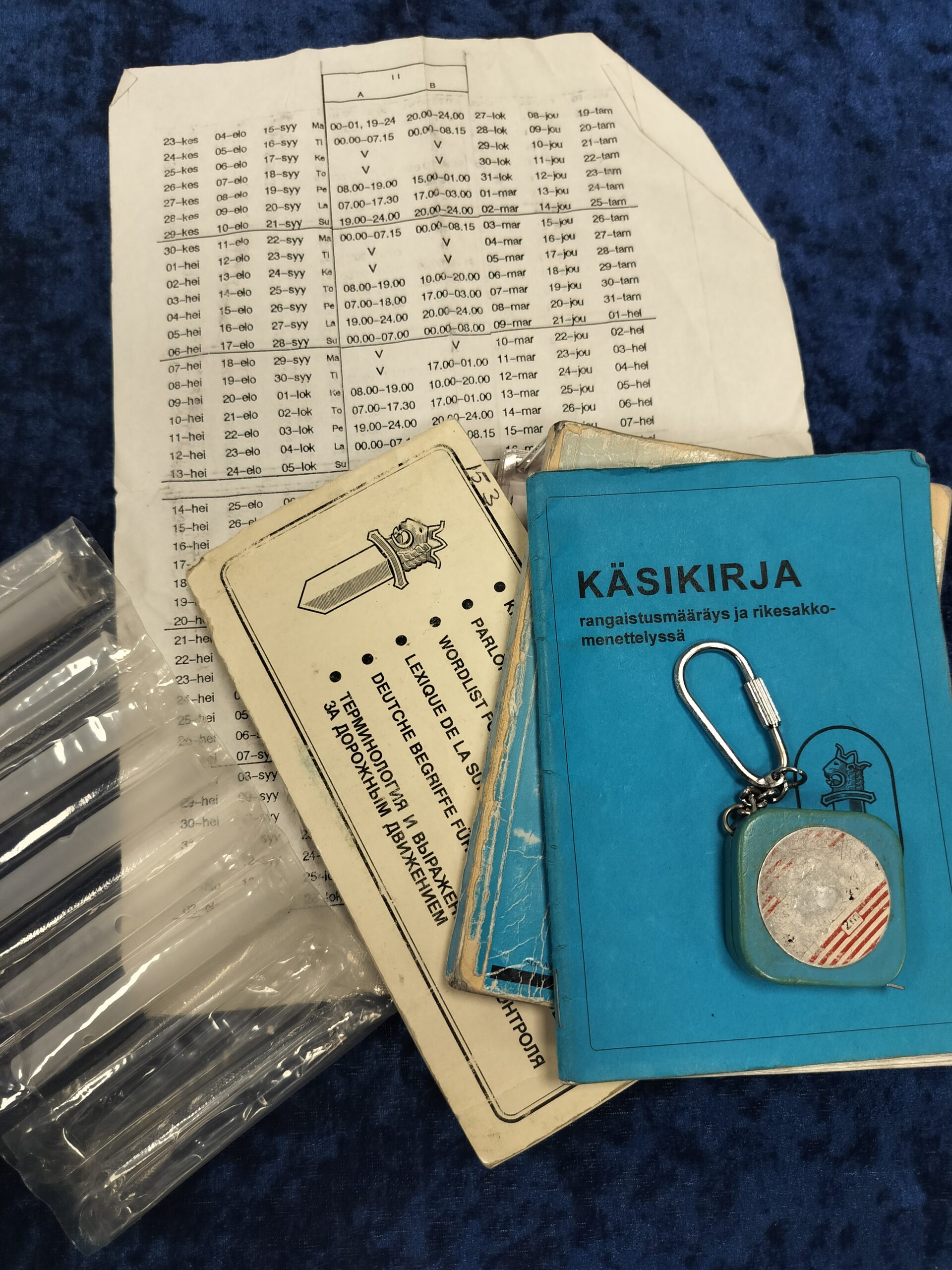
These items that belonged to Senior Constable Antero Palo are stored at the Police Museum.

In October 1997, a Danish escaped convict killed two policemen execution-style on Tehtaankatu in Helsinki. The act shocked Finnish society. The press followed events closely, and the police were flooded with tips from the public. There was also great shock and concern among police officers when the perpetrator was not immediately found. Many police officers recall the atmosphere of shock in the workplace. In addition, the police officers’ loved ones were concerned. Some police officers only became aware of the events the following morning when they received phone calls from their loved ones. The mother of one of them began a call with: Good, you’re alive! Two police officers have been shot in Helsinki.
On a dark and rainy evening in Vihti in June 2016, a bullet fired from a military rifle injured one police officer and killed another following long standoff.
An escaped prisoner from Denmark shot two police officers in Helsinki in 1997
At 2:43 am on 22 October 1997, the Helsinki police were alerted to a robbery at the Palace Hotel. Sergeant Eero Holsti and Senior Constable Antero Palo were on patrol near the hotel when they heard about the robbery. Shortly afterwards, they approached a man walking down the street to see if he had anything to do with the robbery.
As one of the police officers checked the robber’s description via police radio, the man decided to act. He pulled out his pistol and pointed it at the policeman near him. He told him to walk towards the car, and forced the other policeman out of the car. He then ordered the police officers to lie down on the street next to the police car.
Palo got onto his stomach, while Holsti remained on his knees. This made the robber nervous, and he pointed his gun at Palo and told him to tell Holsti to lie down too. At that moment, the robber fired his gun, hitting Palo. Holsti said something and the man shot him in the back. He then fired a few more shots at the police officers and fled the scene.
The first patrol to arrive was Senior Constable Mikko Aro and Sergeant Keijo Saarinen. Aro immediately saw that there was nothing more that could be done. It was Saarinen’s job to call in reinforcements: The men are lying on the ground, shot twice in the head. Get some people over here right now! Two of our brothers have been shot!
Holsti and Palo’s patrol car was still running, lights on. Aro opened the driver’s side door and looked inside the car. The automatic gearbox was in the P position. In the recess of the dashboard facing the passenger seat was Holsti’s uniform cap. Something really strange had happened. Holsti never went on an operation with a bare head, everyone knew that. Aro turned off the engine, switched off the lights, and closed the door. Excerpts from Linda Rantanen, Poliisit murhattiin Helsingin Tehtaankadulle, Suomalaiset poliisisurmat, 2024. (Linda Rantanen, Police officers murdered on Tehtaankatu, Finnish police murders, 2024.)
The police immediately launched a massive manhunt to catch the murderer. There was CCTV surveillance between Hotel Palace and the scene of the killing, which gave the police an idea of the perpetrator and his escape route. Although there were no eyewitnesses to the murders, the police received hundreds of tips. One of them led the police to an apartment hotel near the scene of the killing. The police had decided to check the apartment hotel in question, where they found property belonging to the suspect. The Palace receptionist identified the man from a photograph. Based on the information received, there was reason to suspect that the man was Danish. This was confirmed by the Danish police, who said the killer was a Danish fugitive with a history of serious crimes.
Despite a police blockade, the perpetrator managed to escape from Helsinki to Hämeenlinna. The decisive tipoff came from a pharmacy in Hämeenlinna. The man had been to the pharmacy, and the name on the prescription gave him away. The killer had seen his name on teletext, knowing he was about to be caught. He left through the back door of the hotel and was apprehended by police a few hundred metres from the hotel on 25 October. He did not resist arrest and was no longer armed.
The killer was sentenced to life imprisonment for firearms offences, aggravated robbery and two counts of murder. He is serving his sentence in Denmark and, as of 2025, he has not been released on parole.
Memories of the Tehtaankatu police killings
I was working in Helsinki when Eero Holsti and Antero Palo were shot in 1997. We weren’t on the same shift, but I knew them both and we’d talked. When the incident came to light, I called the duty manager at Pikku Roba and asked whether I should come in to work. Most of us came.
A couple of nights after the incident, we were on a night shift, and we drove to the place where the shooting had happened. We parked the car on the kerb. There was no one around. I jumped out of the driver’s seat and went to stand on the pavement roughly where they’d been shot. The place was full of candles and flowers. It’s a feeling that’s hard to explain. It made me wonder what they’d been thinking about, and how such a thing could have happened.
There was a smoking room on the second floor of the Roba police station. I was still a smoker at the time, and there I was, listening to the older officers sitting with their cigars and reminiscing. Holsti smoked small cigarillos and was highly respected as a man who was on the cusp of retirement. We young “rogues” wanted to sit and listen to him talk. Many times I thought “everything is under control” when calm men like him explain how the world works. But when that man is shot in cold blood from behind in the street, it fundamentally shakes your basic sense of security. Any violence against the police always seems to feel close to me. Details of the events in Vihti brought that feeling back again.
The killings shocked the entire police force, especially when the modus operandi came to light. For the colleagues who were closest to these events, it has of course been many times harder. The grief of the colleagues who were closest to Holsti and Palo was palpable. I saw even older police officers crying. The funeral was held at St John’s Church. There were a lot of us there. When you lived with that grief, it somehow also brought us police officers together. The sisterhood and brotherhood that runs through the whole organisation is invaluable.
After the murders, when the perpetrator had already been caught, there was a nasty situation on a night shift. At Rautatientori, we picked up a drunk who was causing a disturbance on a bus. On the back seat of the police car, he mockingly rattled off the names of the slain police officers and the Danish fugitive, suggesting that the guy could take us out next. It did get me a bit riled up, but my partner and I handled the situation calmly and professionally. Marko Lehtoranta, Sergeant, Police University College.
A man killed a police officer with a military rifle in Vihti in 2016
I can’t deny that what happened has left a mark on me. I was so close to Tomi when it went down. I thought for a long time that I’d never be rid of that sight or forget what his face looked like. Of course, Tomi is not forgotten and will never be forgotten, but those cruellest memories have faded a little. Excerpt from Antero Timonen, Tilanne oli poikkeuksellisen yllättävä. Linda Rantanen, Suomalaiset poliisisurmat, 2024. (Antero Timonen, It took us completely by surprise. Linda Rantanen, Finnish Police Murders, 2024.)
The Western Uusimaa police were called out to the home of a Vihti-based lorry entrepreneur at 8:53 pm on Friday 17 June 2016. According to the information received by the police, the man had shot his nephew with a slingshot-like weapon while the boy was driving a tractor on the neighbouring property.
The first patrol to arrive cordoned off the area. Based on the initial information, the police set up a Critical Incident Response Team, consisting of eight patrols. The police officers wore camouflage and heavy body armour. The shooter’s house was dark. No one responded to the police’s orders and phone calls.
At 11:29 pm, a task force of four police officers from the Western Uusimaa Police Department’s critical incident response team went to the main entrance of the building to check the interior. When the police broke the lock on the door, the shooter’s wife came to the porch and then immediately returned inside. The police stopped breaking in and instead issued more orders.
At 11:32 pm, the police resumed the break-in via the front door. As soon as the door had been opened, the man fired several shots at the police officers standing at the door. Senior Constable Mikko Venäläinen, the head of the task force at the front door, returned fire, shooting three times but missing. Venäläinen was hit in the elbow. The police retreated to cover.
At 11:25 pm, Senior Constable Venäläinen used his Virve radio to report that he had been hit and was unable to continue his mission. He hid behind an excavator. Senior Constable Tomi Keskinen, who was trained in emergency first aid, was on his way to help the injured police officer. Keskinen was running across open ground when, standing at the front door of the house, the man shot him in the back from a distance of thirty-five metres. Keskinen fell to the ground but was able to report on the Virve radio that he had been hit. He quickly died of his injuries at the scene. He had been shot in the back with an assault rifle in an unprotected area, and the bullet had passed through his body.
Senior Constable Antero Timonen was involved in the Vihti operation and describes the incident:
I went looking for Tomi. The conditions were very difficult. It was pitch black and pouring with rain. I couldn’t move standing up, because the man was still shooting in the yard. I crawled through the long grass blind. About a minute after Tomi fell, I managed to find him. The time was later accurately calculated based on radio traffic, but I don’t remember it. However, I looked for him as quickly as I could in the circumstances. I remember as soon as I saw Tomi’s face, I knew it was really bad, hopeless. Nevertheless, I tried to look for the site of the injury. I took off his helmet and checked if his head was OK. I checked his legs, but I couldn’t locate the injury. I later discovered that he had been hit in the lower back. I couldn’t get a response out of him. I went to evacuate Tomi by crawling through the long grass. I kept hearing shots from the yard. I was afraid he would see us. I crawled backwards, gun at the ready, and pulled Tomi along behind me. It was raining so heavily that the meadow turned to mud. It seemed hopeless to get us both moving; it felt like my feet were just trudging through nothing. However, I managed to move Tomi several metres. I finally positioned myself in the meadow with a willow bush behind me. I thought, if I have that in the background, at least my head won’t be visible from the house. I waited there for quite a long time, protecting Tomi and myself. There were no other police officers on that side. Excerpt from Antero Timonen, Tilanne oli poikkeuksellisen yllättävä. Linda Rantanen, Suomalaiset poliisisurmat, 2024. (Antero Timonen, It took us completely by surprise. Linda Rantanen, Finnish Police Murders, 2024.)
The situation was still in progress at the house. Three police officers took cover in a caravan at the back corner of the house. The shooter and the police exchanged several dozen more shots, and one bullet fired by the police hit the man in the forearm, passing through his arm and into his left side.
At 11:45 pm the man shot himself. The police were unaware of the suicide until around 1 am, when officers from the Helsinki Police Department’s Karhu Special Intervention Unit arrived on the scene. They ordered the man’s wife out of the house, and the property was cleared. In addition to two assault rifle magazines used in the shooting, 11 fully loaded magazines, other unlicensed firearms, three slingshots, dynamite and almost 1,700 cartridges were found in the house. The man was found in the yard of his home at 1:32 am on 18 June 2016.