

Scenes where crimes and accidents have taken place must be cordoned off during the investigation. © Jenna Lehtonen/Police
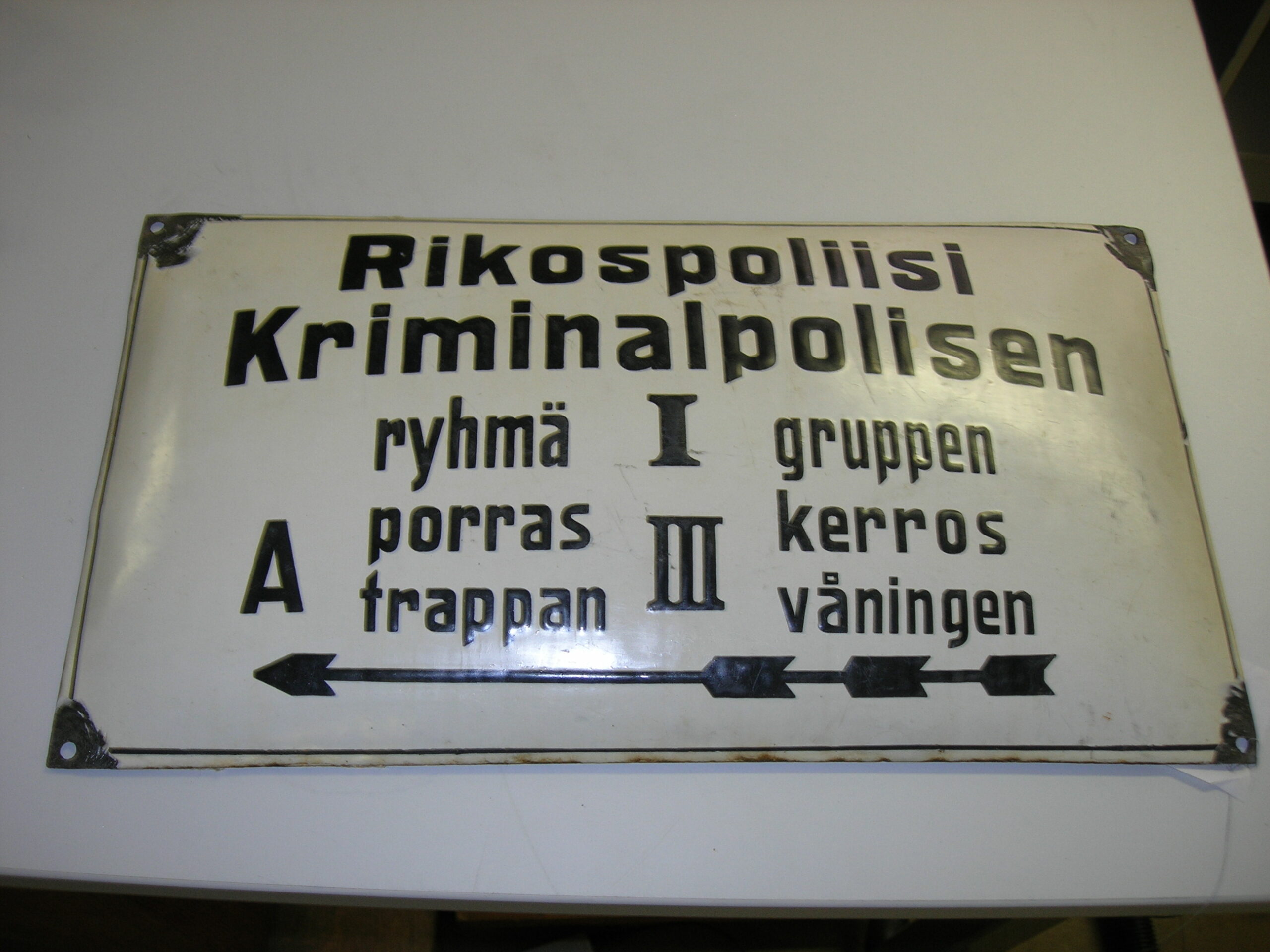
Sign pointing the way to the criminal investigation office of the Helsinki Police Department in the 1920s and 1930s. Detective police investigate and uncover crimes and present the suspects for consideration of charges. Their tasks also include crime prevention and development of criminal investigation procedures.

If a death is associated with a crime, the police must gather all available information and evidence pertaining to the case. They search not only for information that can be used against the suspect, but also for facts that can be used by the defence. ©Juuso Jonninen/Police.

Although I can explain death in a professional capacity, I must admit that there is something more to it than just biology and professional knowledge. Working with death makes you humble. It makes you try your best to work things out. Death should never be treated lightly – the investigation should go as well as it possibly can. We should not settle for ‘good enough’.
At the Police College, Erkki Salo, a criminal investigation instructor, talked about the demanding nature of criminal investigation in a way that I strongly identified with. Behind it all is the idea of justice. The relatives and society as a whole expect clarity, and I wanted to be involved in this work.
I’ve wanted to take on challenges. Even though you are sometimes out of your comfort zone: that, if anything, contributes to professional development. Solving a big, demanding case and wrapping it up made the work meaningful.
Sergeant Marko Lehtoranta. He worked in demanding criminal investigations at the Tampere Police Department from 2003 to 2015. Since 2016, he has been teaching forensic investigation at the Police University College.
The establishment of the cause of death is regulated by law, and it must always be confirmed before burial. In Finland, the cause of death is investigated medically or forensically. If the death was due to disease and the deceased was treated by a doctor during their final illness, the attending doctor or a doctor at the health centre prepares a death certificate and issue a burial permit. An autopsy, also known as a postmortem examination, can be performed if necessary.
In Finland, only one-fifth of deaths are investigated by the police. A common misconception is that the police investigate all deaths in the home, for example. The police will conduct an inquest if the death was unexpected, not known to be caused by disease, or suspected to be caused by crime, accident, suicide, poisoning, occupational disease or medical treatment. Deaths in unusual settings, such as in police custody or during military service, are also investigated forensically. The primary objective of a police inquest is to reliably establish the cause and manner of death and ensure that a possible crime is not hidden. This safeguards citizens’ legal protections and the integrity of the justice system.
If the death involves a crime, the police are responsible for gathering all available information and evidence relating to the incident. The investigation must be fair. This means that the investigation is as much about finding evidence against the suspect as it is about finding evidence in favour of the suspect. No one may be treated as guilty until a court decides they are guilty. A criminal investigation is a formal and legal process to establish the truth about a suspected crime and lay the groundwork to decide whether the case can proceed to court.
Once the investigation is complete, the police close the investigation and prepare a pre-trial investigation record containing all the material. The entire case is then referred to the prosecutor for the consideration of charges. If the evidence is sufficient and there is probable cause, the prosecutor will file charges, and the case will proceed to trial.
The most devastating situation for relatives is when a person has been missing for a long time but is found neither alive nor dead. In such a situation, communication and interaction with relatives is particularly challenging. While relatives probably know in their hearts that the long-lost person is dead, finding the body would give them closure – something to bury, and a place to go and remember the person.
Living in uncertainty is something you can probably imagine, but you can’t get into the pain. It’s as if it hangs in the air all around you. In addition, the media occasionally brings these issues up again, which certainly doesn’t help.
In 2007, I was at a seminar in Oulu, where I heard an impassioned speech by the mother of a person who had been missing a long time. A crime reporter also gave a presentation, defending the way his tabloid newspaper reported on crime. A critical question was raised from the audience, asking whether the style of their writing was offensive to the relatives and showed disrespect, because news coverage seems more like a greedy money-grab than a humane endeavour. The journalist got a bit nervous and defensive, saying that the relatives are taken into account. I think, however, that the media often lack respect for the relatives and don’t give them peace. Sergeant Marko Lehtoranta, Police University College.
Forensic medical examination of the cause of death
When a person is found deceased in unclear circumstances, a uniformed patrol is usually the first to arrive. The officers isolate the area and ensure that nothing is touched. At this stage, the investigating officers have already been informed. The first step is for the forensic investigators to put on protective equipment and examine the deceased and document any injuries and the circumstances on the scene. Pieces of evidence such as fingerprints and DNA samples are collected. They report the crime, and the deceased is taken for an autopsy (postmortem examination). The forensic pathologist obligates the police to be present at the autopsy. In unclear cases, fresh findings and medical reports are crucial to the investigation. When the forensic investigation of the scene is complete, tactical investigators arrive and take responsibility for moving the case forward. Ideally, both investigations should be involved from the outset.
The police invite the suspect and witnesses to explain what happened. In more serious cases, the police may have to take action as permitted by law. For example, they may need to arrest a suspect or search a home in order to solve the crime.
Delivering bad news is one of the most demanding tasks for the police
As the police are responsible for establishing the cause of death, they also break the news of the death to the relatives. This is one of the most demanding tasks for a police officer. It requires preparation, empathy, and strong professional skills. Whenever possible, the message is delivered face-to-face. It is not advisable to deliver such a message by telephone, unless the relative is unreachable, for example, if they are abroad. Two police officers usually go together.
The reactions of relatives range from extreme, crushing sadness to shock. A person in shock may appear calm, focus on secondary activities such as making coffee, or even refuse to believe it. The latter is the most uncomfortable situation for the messenger, because they cannot be completely sure whether the person has understood what they were told.
When a person opens their door to a police officer bringing news of the death of a relative, their life is transformed instantly. The information is devastating and unique. Although it is one of many official duties for a police officer, it is not a duty that is taken lightly or handled quickly. It must be done without haste, with respect and dignity.
A colleague and I once investigated a case where a young man had jumped off the roof of a tall building near the centre of Tampere. At first, there was something in the air, the thought that someone might have helped him jump, but we could find no evidence of it. Once the identity of the deceased had been established, we drove to his father’s apartment in Annala, near Kaukajärvi, and as usual, we went through all the relevant facts about the case in the car. We agreed that I would do most of the talking, but if I was unable to speak for one reason or another, he would take over. According to the Population Information System, the father lived alone.
I rang the doorbell, and an older male person opened the door to us. We introduced ourselves and made sure he was the person we were looking for. I asked if we could come in. I told the man that his son had committed suicide. The man said nothing, but showed us in and asked if we wanted coffee, which we politely declined. The apartment was rather austere, but clean. The kind of apartment of a lonely older man. The air was perhaps a little stuffy, but it looked like everything was being taken care of. The living room had an oval-shaped coffee table, two armchairs, and a small sofa. A bookshelf on the wall. Simple, but functional.
The man asked us to sit on the sofa, walked silently over to the bookshelf, and picked up some photo albums. He came to sit on the sofa between us and opened the first album. We all sat in silence and looked at the photographs. He showed us pictures of his newborn son, pictures from christenings, birthdays, kindergarten, school pictures, confirmation pictures, you name it. The atmosphere was palpable. The man sat between us, poring over the albums, and I glanced briefly at my colleague and saw that he was also moved. It’s hard to put into words what I was thinking, but there was something about that moment that I’ll never forget. We went to tell him about the death of his only child, and he wanted to show us his son’s life story through photographs. It was a great honour. Delivering news of death to the father, Sergeant Marko Lehtoranta, Police University College.
Nowadays, increasingly often, a priest or crisis workers from the emergency social services go on operations with the police. They can stay behind with their relatives after the police have left. When the operation is complete, the patrol usually reviews the situation immediately after returning to the car. Sometimes a situation may require further discussion. Keeping things bottled up is not a long-term solution. A good supervisor can sniff out the situation and intervene if there is a need for discussion.