
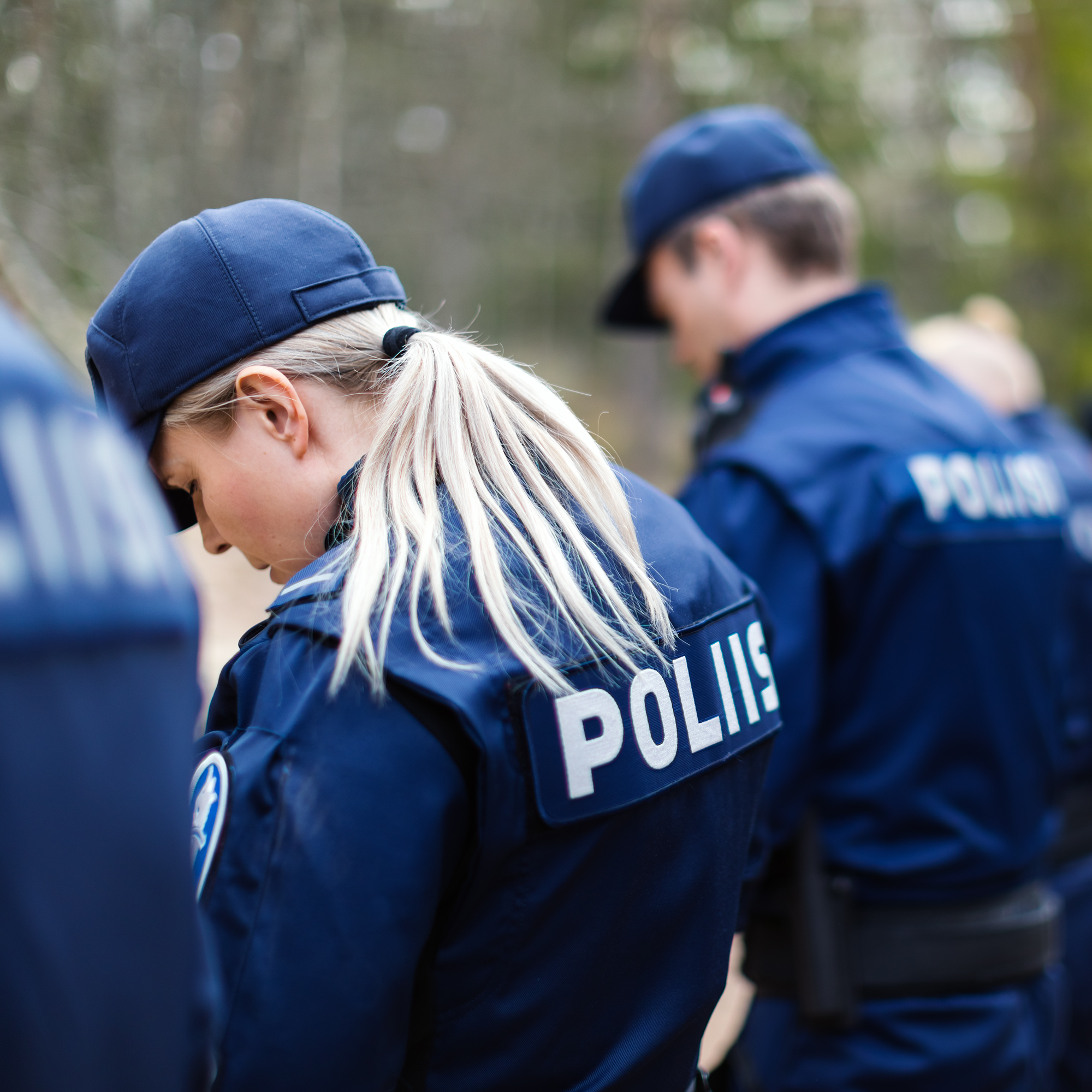
An assignment can suddenly turn extremely dangerous. Every police officer must be aware of and recognise the dangers and risks encountered in his or her work in order to return home safely after each shift. ©Sami Hätönen

Dangerous and stressful situations are part of police work. However, one does not have to face everything alone. ©Sami Hätönen
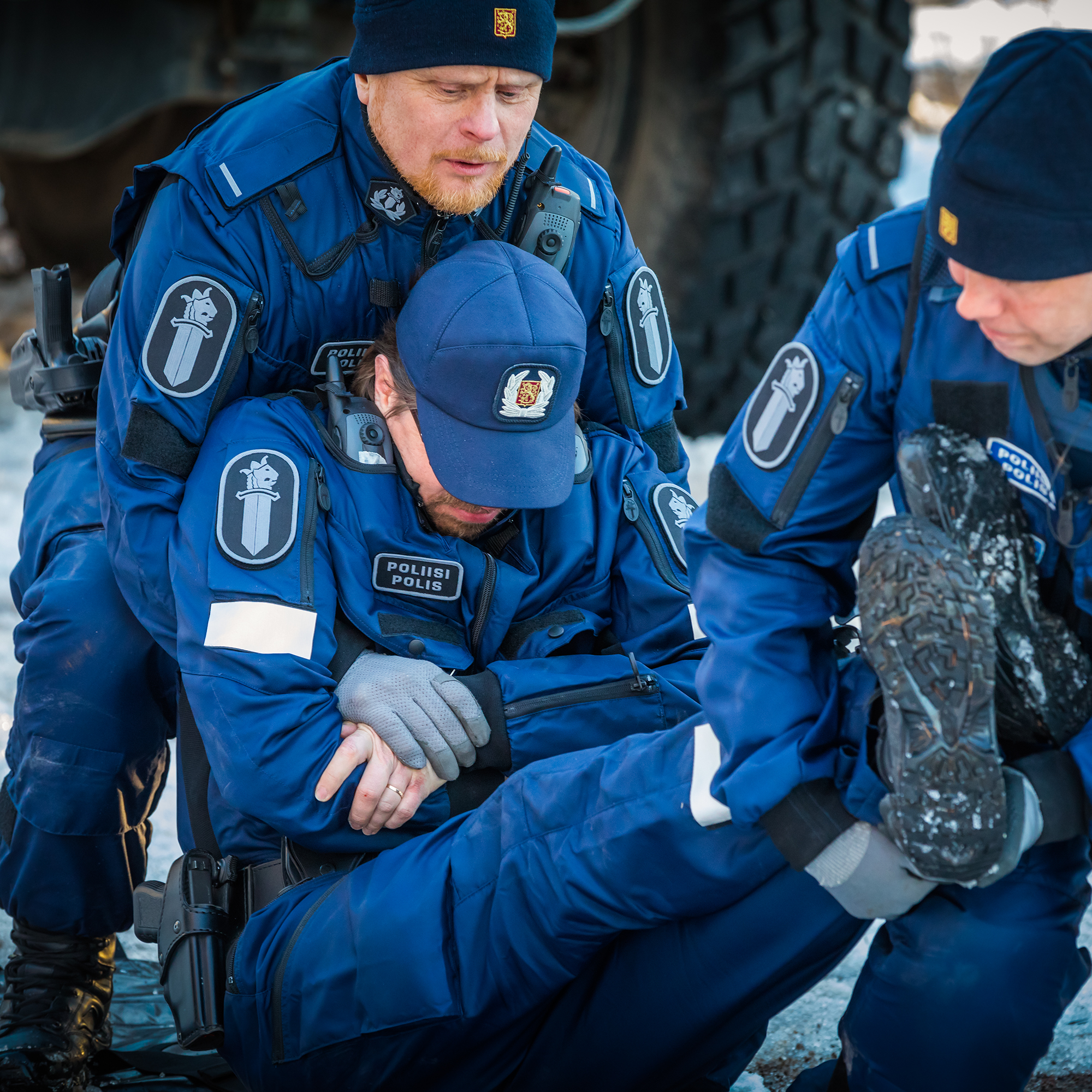
Emergency evacuation exercise. It is important to work as a team in real situations as well rather than attempt to play hero on one’s own. ©Sami Hätönen


Once we got to the police station, we had a short chat with the people there and then went home. The overriding sensation at that point was fatigue, and every muscle in my body felt as tense as a violin string. The overall impact of the event can be best described by the fact that over the next couple of days, I had totally lost my sense of initiative, and I mainly just sat there. Even the smallest thing seemed to require me to make a hard decision: ‘Hey, now you need to get out of your chair.’ After the incident, there was of course a debriefing session in Äänekoski and a separate debriefing session for the rescue personnel in Viitasaari. For me, it was only after that second session that a timeline of events emerged. The incident hasn’t disturbed my sleep or occupied my thoughts. I’ve subsequently reflected that the biggest factor in that was that I talked about the incident dozens of times to many different people and I wasn’t doing the investigation or moving the bodies: I was in the role of situation manager. But I’ll never forget it. Mutta koskaan en sitä unohda. Excerpt from Konginkangas 19.3.2004, Sen keikan muistan. (Konginkangas 19 March 2004, from ‘I remember that mission).
Critical incidents and stressful situations cannot be avoided in police work. Anyone in the police force may have to face and deal with the consequences of these situations. For example, in 2008, after the Kauhajoki school shooting, customer service staff working at the police station responded to calls from distressed relatives and the media alike, under great pressure. Stress can take its toll on anyone’s mental and physical wellbeing. A critical incident can become a traumatic experience.
The police do not need to put up with everything
Although police training and selection processes emphasise mental strength and resilience, neither a professional role nor a uniform is a protection against traumatisation. It is not a matter of human weakness or personal choice when to be traumatised and when not to be. The symptoms can be very intense, but there is nothing you can do about them. Over the years, we at the Police Museum have heard of numerous missions that will not be forgotten. For some, it was an armed threat, a home call-out that took a sudden turn, being the first patrol to attend the scene of a family murder, school shooting or major accident, an injury to a colleague, or visit the home of parents whose baby died of cot death. There are many examples. Places, smells, sounds, individual phrases that come back to haunt you after so many years. Long-term investigations, such as ones into crimes against children, can also cause stress to pile up and end in trauma.
The police have a long history of tolerating violence and demanding situations. For a long time, it was held that unpleasant things were just a part of the job, and officers had to cope with the stress inflicted by burdensome cases on their own initiative, as they saw fit. For a long time, the only peer support for police officers was talking to a familiar patrol partner, and this avenue has not lost its importance. Many people have unpacked their experiences on the sauna benches with the help of their workmates and an alcoholic drink. Talking things over with a patrol partner while driving to a job is still a very important form of support when officers discuss more personal matters alongside work. In the coffee room, any topic goes, and people can find the funny side, even in difficult subjects, in a way that outsiders would not understand.
The police profession is a community-based one. In the past, it has been reinforced by, among other things, boarding-school-style living and shared hobbies, especially sports. This sense of community has been a driving force in many of the stories we have heard. Today’s sense of community has changed, but the special nature of the profession remains the glue that holds it together.
Debriefings in the early years
Occupational safety and health are legal obligations for employers. In Finland, employers are obliged to look after their employees’ mental and physical safety and health at work. Facing and resolving difficult and challenging situations must not be left to the individual worker or the team involved. The employer must investigate and identify hazards and harms in the workplace and, where possible, attempt to eliminate or mitigate their impact.
Debriefings became a hot topic in the 1990s, when aftercare was also seen as a necessity for the police profession. The old-fashioned attitude of ‘we don’t need any shrinks here’ was fading. The work community noticed this when colleagues received help and did not fall into a downward spiral of alcoholism or incapacitation.
The issue of aftercare was discussed in 1986 after the Jakomäki-Mikkeli hostage drama. Both the surviving hostages and the police were left without aftercare. The psychological after-effects could have already been treated and mitigated with outside help. The Police Administration ruled out this option at an early stage and focused largely on finding the perpetrators.
In 1993, Senior Constable Antti Murtomäki died when a fleeing car in Lauttasaari, Helsinki, hit him without slowing down or taking any evasive action. A debriefing session was held at the Helsinki police station in connection with the incident. The session was attended by everyone affected by the case, including the supervisors. The car and passenger ferry Estonia sank in late September 1994, killing 852 people. The rescue services and the police were particularly affected by the tough and demanding rescue and investigation work. After the Estonia sank, Turku Police Department launched a system of progressive debriefings.
The first nationwide regulation on aftercare for crises came into force in 2012. Debriefings are conducted by a specially trained police officer immediately after the incident. A debriefing must take place before the end of the shift of those involved in the situation. Attendance is mandatory, but the follow-up measures are voluntary. The moderator must be a person who was not involved in the incident.
The debriefing is based on peer support. It is an opportunity for listening rather than treatment – a way of going through an unusual mission among the police officers involved. Debriefings – also referred to as defusing – can play an important role in maintaining the functional capacity of employees, and, at the very least, it helps participants to understand what emotions they may be feeling after a traumatic or critical event and hear what other people in the same situation are thinking.
A debriefing must be organised:
- in situations involving a weapon
- in threatening situations where the police have had to use a weapon
- in the event of a death, the death of a colleague, or a serious injury
- when a police officer has been subjected to violence or the threat of violence
- in a particularly shocking situation
- in the event of a police threat
- when a police officer has been targeted
Debriefings should be held readily if a critical work situation has involved a student in practical training, an employee at the outset of their career or in a new position, or an otherwise inexperienced employee.
Post-trauma workshops
After the Kauhajoki school shooting (2008), the police introduced post-trauma workshops. The initiative was taken by Sergeant Pasi Härkönen and Detective Chief Inspector Juha Järvelin, a doctor of administrative sciences who wrote his thesis on occupational safety in the police. Although crisis assistance was available in the police, it was still inadequate. They invested their own time and money in familiarising themselves with post-trauma workshops in the United States and decided to bring the model to Finland.
Finland’s first post-trauma workshop was held in 2010. Since 2012, they have been held twice a year. Currently, three-day police post-trauma workshops are held twice a year. The results have been encouraging, and the participants have received concrete help with their post-traumatic symptoms. Post-trauma workshops can be attended as part of aftercare once at least six months have passed since a critical incident. Those experiencing cumulative stress due to their work can also participate in the workshops. Anyone who needs a post-trauma workshop can apply for it, and, with the person’s consent, they can also be referred for a workshop by their line manager or the occupational health service. The workshop is intended for all employees of the police administration – not just police staff, but also, for example, guards, and those working in specialist, licensing, administrative, and headquarters functions.
Poliisin tuki ry helps in urgent cases
Poliisin tuki ry, the Police Support Association, raises funds for the rehabilitation of police officers who have been seriously injured in the line of duty and to support the families of police officers who have died in the line of duty. The support can be a one-off payment or longer-term assistance. In particular, in the event of death, immediate action is taken to support families. This is the association’s strength, as it provides quick access to support measures without cumbersome bureaucracy at a time of urgent need.
Founded in 1964, the Police Support Association is backed by the Finnish Police Union, the Finnish Police Chief Association, and the Association of Police Lawyers. The association is politically neutral and does not participate in trade union activities.
The association’s assets include shares, and the income from them is used to distribute grants. In addition, the association raises funds by collecting annual fees from its member associations, receiving donations or bequests, organising fundraising or raffles, or selling promotional products. In the spring of 2025, the Helsinki Police Symphonic Band organised three ‘Guardian Angel’ concerts and donated the proceeds to the Police Support Association.
The association only provides financial support, but the members of local associations can help a family in need in many ways. At a time of urgent need, emotional support is provided, along with tangible action to help. For example, helping with gardening or an unfinished building project, going shopping, or taking children to their hobby activities.
One patrol was providing official assistance in 2021 when the situation changed in an instant. The police officers were waiting outside for the social services officials to exit, and then everything changed. A man suddenly shot one of the police officers in the head from a distance of about two metres. The officer survived the incident with surprisingly minor physical injuries, but it took some time to recover mentally. This is where the Police Support Association stepped in.
The grant from the Police Support Association meant that I didn’t need to worry about my expenses or loss of earnings or other financial affairs. Of course, my family was also affected by the whole case, and the support also helped to cover their expenses. Not only that, but it will also allow me to cover future costs and any treatments I might need in the future, especially for my family members. I find that as I write this, the feelings I had 18 months ago are bubbling back to the surface, my heart is starting to race, and my hands are sweating – it is all coming back so clearly. It has been a long process, and the final resolution came from the Court of Appeal only in late winter 2023, almost exactly one and a half years after the event. I feel that only then could the final recovery begin. Excerpt from Ei tarvitse enää lotota, Sen keikan muistan. (No need to buy another lottery ticket’ from ‘I remember that mission)